|
Ref: MAT2_B02 |
|
Part B –2a |
2.a North American Society & Movement
|
|
Excerpts & Historical Context: Parallel Lives in Perspective |
|
Quotes from interviews of Wanda and Jack |
|
|
Wanda’s Early Life: We actually
moved into |
Wanda with Colleagues in the We [Wanda & 3 co-workers: Wink, Jerry &
Glenn] are going down the mountain.
And Jerry stands up and she is screaming. And Wink and Glenn are still trying to
maneuver so they can get a hold of the wheel.
And Jerry is screaming. And I
smacked her in the face, and said: shut up! And I'm sitting there going
"steer into the side of the mountain!" And that's how we were stopped; they
steered into the side of the mountain. But, it was a horrible experience. –
Wanda D. Keefe |
|
Jack in the The Russian subs were there[west
coast of |
Wanda as Foreigner entering USA JJK: [Wanda
went] to WDK: I
was disgusted with how they treated the others -- because there was a lot of
Russians coming into the country and a lot of other people coming
through. And they treated me very
nicely because I spoke English, I was Canadian. But some of those people who couldn't speak
English, that were coming across, they really treated them like cattle. And I was telling Mom about how disgusted I
was. And I said: "a terrible way
they treated the foreigners" and
his mother started to laugh, she said “what do you think you are?” I said you
know, you're right, I never thought of that. (Laughter) |
Interview Abbreviations: JJK
= Jack [John Joseph] Keefe; WDK
= Wanda Davis Keefe; AKK
= Adhiratha Kevin Keefe
|
Table of Contents 2.a North American Society & Movement................................................................................................................. 1 Jack & Wanda's Parents and Relatives................................................................................................................................... 2 Wanda’s Cabinet Maker Father & Great Aunt
Athabasca Trail Driver...................................................................................... 3 Wanda's Relatives served in the Civil War]................................................................................................................................. 4 Movement
during Depression and Before War:.................................................................................................................... 4 Selling family furniture to survive during the
depression............................................................................................................ 6 People moving, taking odd jobs “Honey Wagon”, Relief & Welfare.......................................................................................... 7 Wanda's Schooling and sports..................................................................................................................................................... 7 Adjustment From a One room schoolhouse to city
/school -WDK............................................................................................ 8 High School Career Planning l –WDK........................................................................................................................................ 8 Polio, Jack Schooling and Sports Illustrated
presentation................................................................................................ 9 Principal wanted Keefe to go to a special school...................................................................................................................... 12 Jack and Wanda’s Yukon Work Experience......................................................................................................................... 12 Midnight Recreation Picnics...................................................................................................................................................... 13 END Note list for B-2................................................................................................................................................................ 13 |
[B-2 Web version Continued in
B-02b]
Jack & Wanda's Parents and Relatives
Jack and Wanda were
raised in
Some of the interview stories illustrate that Wanda’s family
had a history of mobility dating back to before the
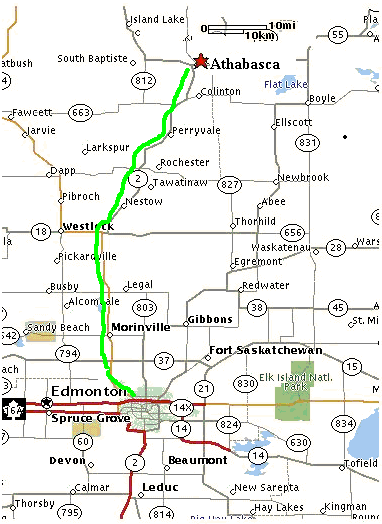
Wanda’s Cabinet Maker Father & Great Aunt Athabasca Trail Driver[excerpt for full see jw00au14.rtf para 20] JJK: [Wanda's father] started in life as an
apprentice cabinetmaker. As a
matter-of-fact we have the cabinet which he made when he was about 14 years
of age. And it was all made with hand
tools. None of the electric tools or
anything like that. And of course he
had been a farmer for years near |
|
|
|
JJK: One of your grandaunts,
[Wanda’s] Aunt Ella,
as a youngster was very blond of German extraction. Her father was a drover and transported
material from |
Wanda’s immediate family lived in western
Wanda's Relatives served in the Civil War][Except see jk00ap16.doc para 3 & 4 Common Families involved, Great, Great Grandfather/ AKK What
do you think and specifically about how the common families were involved?
[in the JJK. Well
we can look at that from the standpoint of your mother's[Wanda’s] family. Her
Great, Great Grandfather was
a man by the name of |
This next section provides excerpts of stories and secondary source comments which may give some of the flavor of the times .
Movement during Depression and Before War:
Wanda's parents and siblings were similar to others who had to
move around during the Depression in order to find work and keep
the family together. Jack and Wands were well aware of the devastation
|
[excerpt: see
jw00se30.rtf para 15] AKK: There was a lot of movement
during the war too? People moving
across country. Jobs were better here
-- there. WDK: Oh Yeah. Well, that had even
started before the war. Because of the
Depression. Whole families were packing
up and leaving. JJK: Sure, the Okies
[Oklahoman, Texans and others trying to escape the devastation caused by dry
weather in the Dust Bowl and farm mechanization]. They picked up and went to WDK: The
rest of the country, I mean California was very uninhabited for long time
until the big storms, the dust storms and everything in JJK: They used to call it the
dirty 30s. The dirty 30s. Because of the dust storms. WDK: The world really changed
tremendously with the second world war.
And it was a terrible war but it also changed the whole economy. |
|
[jw00se04.doc
para 3] AKK: You lived by yourself. And then Gwen [Wanda’s Sister] came and
joined you when you were working in WDK: Right.
When I finished up at the hospital, and went to work on the south side at the
Treasury Department. In the bank. My mother and father then went up to AKK: But,
it was pretty good pay for that time? WDK: Yeah,
for then it was. And Gwen and June went with them first and then
Gwen had to finish high school, so she came and lived with me |
The
Wanda Davis Keefe,
|
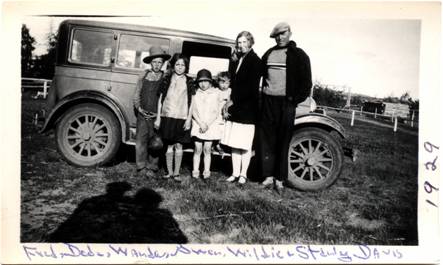
Figure 5 = 4.d 1929 Fred,
Wanda, Gwen, Wildie & Stanley Davis The
|
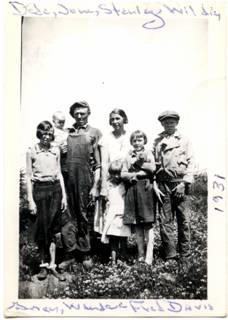
Figure 6 = 4e 1931 Dede,
June, Stanley, Wildie, Gwen, Wanda, Fred A
candid Shot of the |
Selling family furniture to survive during the depression[excerpt see jw00se04.doc para
4] AKK: When was the
time you told me it was really tough, where you would get some money together
and then you would buy back the beds you sold? WDK: 0h, that was when we lived in AKK: That
was during the Depression? WDK: Very
much so. After we first moved in
there. We actually moved into AKK: And
at least she wouldn't have to board then too.
And you would be together? WDK: Right,
right. And be with the family. And that's why we moved to AKK: And
that was pretty common to everyone at that time for what I hear everybody was
moving around and... WDK: Oh,
yeah! It was terrible. Jobs were scarce. That's when men were really selling apples
on street corners. I even remember
that. AKK: All
the way up there? I know in the big
cities down here they were, but up there too? WDK: Yeah, they were doing the same
thing there. And they were riding the
freight trains. Wasn't surprising at
all to see somebody at your back door asking for sandwich or a cup of soup or
something. And they moved from here to
there just trying to get by, trying to live. AKK: And
it wasn't considered sort of unrespectable at that time, it was just what did
you do. At least they were moving
around trying to get work? WDK: Right,
right, right. And they would come and
say "Can I chop wood for the day for a meal?" and all that. No, it
was tough, it was very tough times. People are more familiar with it in the |
People moving, taking odd jobs “Honey Wagon”, Relief & Welfare[excerpt see
jw00se04.doc para 5] AKK: Basically, people were moving around. They were doing anything. They put all their belongings from the farm
on the car or whatever and moved to the next town and tried to get something? WDK: We also lived on, what you call here Welfare. We call
it Relief there. But the men worked
for it. They would give them city jobs
going around picking up garbage and junk.
They would work so many days for that.
Then they would get tickets for clothes and money for the family. They would get, vouchers. So my father
worked at jobs like that. AKK: Since they did not have something like running sewage
from the outhouses, did they have to go around and clean them out? JJK: The honey wagons. WDK: That's right.
They had to go and pick that up.
That was a terrible job. AKK: Did they have honey wagons down here too? JJK: Not to my knowledge, no. They probably had been in
different parts of the states. They just didn't have them in AKK: But you knew about the honey wagons and you had heard
her stories. JJK: Well I heard her stories... WDK: We didn't call them honey wagons up there though. No, but they had lots of funny stories
about it. But the outhouses were built for it, with the trap door that came
up in the back. JJK: Sure, when I went with her and met members of her
family before we got married they had the back houses right there. Still there, this is in the city of |
The interviews provided a glimpse
of the different type of background and experiences Jack and Wanda had before
they met in
Wanda's Schooling and sports
Wanda was originally in a one room
school house. But at 11 years of age, she moved to the capital of the
Adjustment
From a One room schoolhouse to city
/school -WDK
[excerpt for full see jw00se04.doc para 02] AKK: We were talking about you going from a one room
schoolhouse to having 40 children in
class. What was that like for you? WDK: Scary, it was really overwhelming. When I look back. I didn't like it. I was very unhappy for quite awhile. I did not want to leave the farm in the
first place. You leave all the animals
,including your horse which you rode
all the time. All the great things about a farm you leave to go to the city.
And then of course there are all the city kids that are making fun of the
hicks from the farm. AKK: How old were you? WDK: Eleven. AKK: They all had bicycles when you had a horse? Some of them had bicycles? WDK: Not all of them. High School Career Planning l –WDK
WDK So, I finished up at the Eastwood school. I finished there and went to
start grade nine, which was high school at Eastwood. I went there for two years, grade nine and
10. And then talked my parents into
letting me go to a commercial high school.
To switch. Because I wanted to take commercial courses. |
Schlesinger reports that in 1935
in New England, basketball was regarded as primarily a pastime for girls
[B02-N01] Wanda has an interesting story about a
long-legged Canadian girl drawn to the sport but withdrawing
because of some unwanted attention.
|
Basketball –WDK [excerpt for full see jw00se04.doc para 03] AKK: You knew you weren't going to go to the University so
you thought... WDK: I didn't want to be a teacher, I didn't
want to be a nurse. My father really
wanted me to be a nurse. I had no
desire to be a nurse at that time. And
I certainly didn't want to teach. I
wanted to get secretarial skills, which I did. I went to commercial high school and graduated from there. We had the Olympic girls basketball team
came from AKK: Was this the other girls who make fun, or the boys? WDK: No, the guys. They would be whistling and would be
calling us “snake hips” and all these remarks, and I just hated it. So I just quit playing basketball. AKK: Was your father encouraging you to play? WDK: Of course. He thought I was stupid when I quit. AKK: You enjoyed it. It was just that other part of it? WDK: I didn't like everyone looking at me and making fun of
me. AKK: Did they travel some too? WDK: 0h, yeah. They
went all over. They went all over the AKK: Then that was the last one. The didn't get canceled for the war then? JJK: They canceled out 1940. AKK: So, did you travel with them at all? WDK: No, no, I just played on school team there. But some also [later played on the Grads]. AKK: That was the
feeder teams? WDK: Right. Right.
The principal of the school was coach of the basketball
team AKK: So he was encouraging you. Were you considered tall? WDK: I was five foot six. Which was quite tall in those days I guess? But, I was all arms and legs and I didn't like the comments. |
Polio, Jack Schooling and Sports Illustrated presentation
Schlesinger notes that summers of his youth were
haunted by the specter of infantile paralysis, as polio was then known.
Children were forbidden from swimming pools and crowded places. [B02-N02] As Jack Keefe puts it, he was
one of the "lucky ones" who contacted polio during that time. The
following excerpt based on an interview
for a popular sports magazine in 1987 tells this story best. Jack’s parents
resisted placing him in special schools because of Jack’s polio produced
disability to his leg. They believed in keeping their son in the “mainstream”.
He walked with the aid of crutches or braces and was a very active youth.
Eventually Jack excelled in swimming related sports on his high school, college
and national ranked community teams.
|
Jack Keefe Family |
|
|
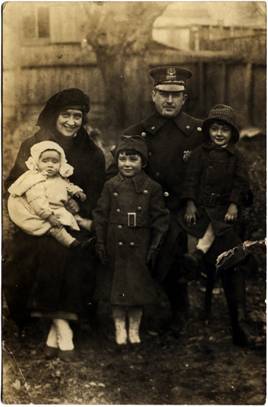
Figure 1 = 4.a 1918 Jack and Bessie Keefe with 3 Children: Tom, Frank, & Jack Jack would be teased later to say his father had the ventriloquist's dummy on his lap |
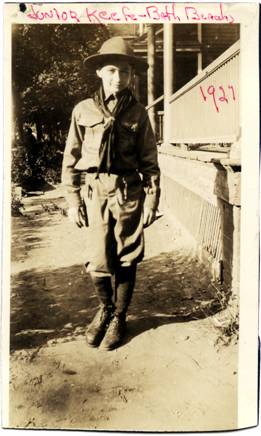
Figure 2 = 4.b 1927 Jack
Keefe, in Scout Uniform |
Excerpt of Jack's Story as
reported in SPOTLIGHT 23 March 1987, Sports Illustrated
|
A MASTER OF A SWIMMER
: Undeterred by Polio, .Jack Keefe is a top backstroker
at 71 By RICHARD DEMAK Excerpt: [for complete text see jk87mr24.doc] |
|
Jack Keefe always sits with his right leg
crossed over his left. That's the way he has sat for nearly 70 years. In
October 1916, 18 months after he was born, the poliomyelitis virus withered
his right leg It made the leg 4'/i inches shorter than the left one and no
bigger around than a the left one and no bigger around than a Little League bat barrel. Recalling the
illness that would change his life, Keefe says quietly, "There were
other children in our family, plus all the kids that I played with—the
Schlesinger kids and the Keefe was one of the best high
school swimmers on After not swimming competitively for almost
50 years, Keefe began entering masters events three years ago. Since then he
has rarely finished out of the first five in national championships, and for
the past two years, he has ranked in the top 10 in the 70-74 age division in
variety of backstroke events. At the 1985 His routine
there was the same as it is at every meet. He sat on the concrete deck
surrounding the pool, his back propped against the stands and his crutches
and brace laid at his side. When the time came for one of his events, he
hobbled to his lane, his right hand clutched around his right knee so that
the arm could thrust the leg forward. He slid into the water, turned around
and wrapped his hands around the railing of the starting block. He drew his
left knee toward his chest while the foot pressed against the pool wall. The
leg was poised to uncoil when he heard the gun. His right leg hung limply
beneath him. [photo Caption page 1 of article: At meets
Keefe supports the religious bent of one of his kids. Pictured wearing
"Sri Chinmoy Marathon Team" sweatshirt] |
|
During a
race Keefe's backstroke looks like everybody else's, but the splash from his
leg kick is smaller. "I try to get some kick out of both legs," he
says. "I have a pretty powerful left leg, but the other leg dangles.
Someone joked that I might be better off if they had amputated that right leg
so that I could lessen the drag. I
guess he's right, but the hell with it." On July 4, 1983, some 11 months before;
Keefe had begun swimming in competition again, William Rynne
and his wife, Virginia, hosted their annual Independence Day cocktail party
at their home in Tuxedo Park, N.Y. Rynne won the
Distinguished Flying Cross in World War II, during which he shot down
five planes and later was shot down himself' and tortured as a prisoner of
war. Rynne knows something about heroism. But when Rynne introduced his friend Keefe to his guests, he told
them that his hero was Jack Keefe. Says Rynne,
"People have given me many medals and dinners, but what I had was just
physical courage. It doesn't compare to the spiritual courage of Jack. He's a
genuine hero." Although Keefe's leg kept the hero's hero
out of World War II, it didn't stop him from competing in sports. "He
was always first over the fence at the "My
father never pushed us, but he always had all the equipment ready,"
Keefe says. "He would play
catch with me by the hour. I told him I was going to be a big leaguer. He
never said anything but 'O.K.' " Before playing
basketball at Seton Hall, Jack's younger brother, George, was a starting guard on the The best
athlete in the family might have been Charlie, another brother. He died at
age 14 while exercising in the basement of their house. He was doing chin-ups when he caught himself on a wire and was
strangled. For weeks Jack's father would go to the basement and scream.
Twenty-nine years later George was killed in a car accident, and that, too,
traumatized Jack's father. "It was not exactly the kind of life that my
father had envisioned," says Jack. "Two sons were killed and
another had polio." |
Principal wanted Keefe to go to a special school When the Keefes moved to the [Page 2 Photo Caption: Keefe consistently
finishes in the top five in his age
division in national championships Pictured doing backstroke in the pool]. Keefe, however, knew that his leg would
prevent him from ever becoming a top-flight collegiate swimmer. So at |
Jack and Wanda’s Yukon Work Experience
Jack and Wanda met and worked together
in the
[B-2 Web version Continued in
B-02b]
END
Note list for B-2
|
<<<go back to Paper
Table of contents page<<
[B-02a Web version Continued
in B-02b]